
Travel insurance
UHIP is your mandatory health insurance plan for when you are studying at Renison for longer than 21 days. UHIP does not cover emergency and health expenses while you are travelling to and from Canada.
We strongly recommend that you buy travel insurance to help cover unexpected costs while you are travelling to Canada (such as cancelled flights and emergency medical costs). UHIP only covers health treatment costs while you are in Canada and studying at Renison.
Travel insurance gives assistance by providing:
- Unforeseen travel misfortunes such as trip cancellation and trip interruption insurance
- Emergency medical assistance (during the period while are you travelling to Canada and are not covered by UHIP)
- Baggage and personal items protection
- Accidental death insurance
Travel insurance is sold in packages, combining various categories of coverage. Do your research and determine what you need and what you do not need.
Your UHIP insurance is only valid while you are studying at Renison or the University of Waterloo. Your insurance is no longer valid when you finish your studies. You should get travel insurance if you decide to travel in Canada for any length of time before or after you study at Renison.
You can buy travel insurance from the airline you are travelling with, a travel agency, your credit card provider, or other online outlets. You can explore and compare travel insurance options at insuremytrip.com.
If you cannot view this video on YouTube, view the video through our alternative link.
Arriving in Canada at Toronto Pearson Airport (YYZ)
The helpful video above is a tool to help you know what to expect when navigating the Toronto Pearson International Airport (YYZ) in Toronto, Ontario, Canada. If you would like to access written instructions, click the collapsible menu below.
Steps when you arrive at Toronto Pearson International Airport
Steps when you arrive at Toronto Pearson International Airport
Step One
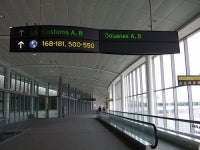
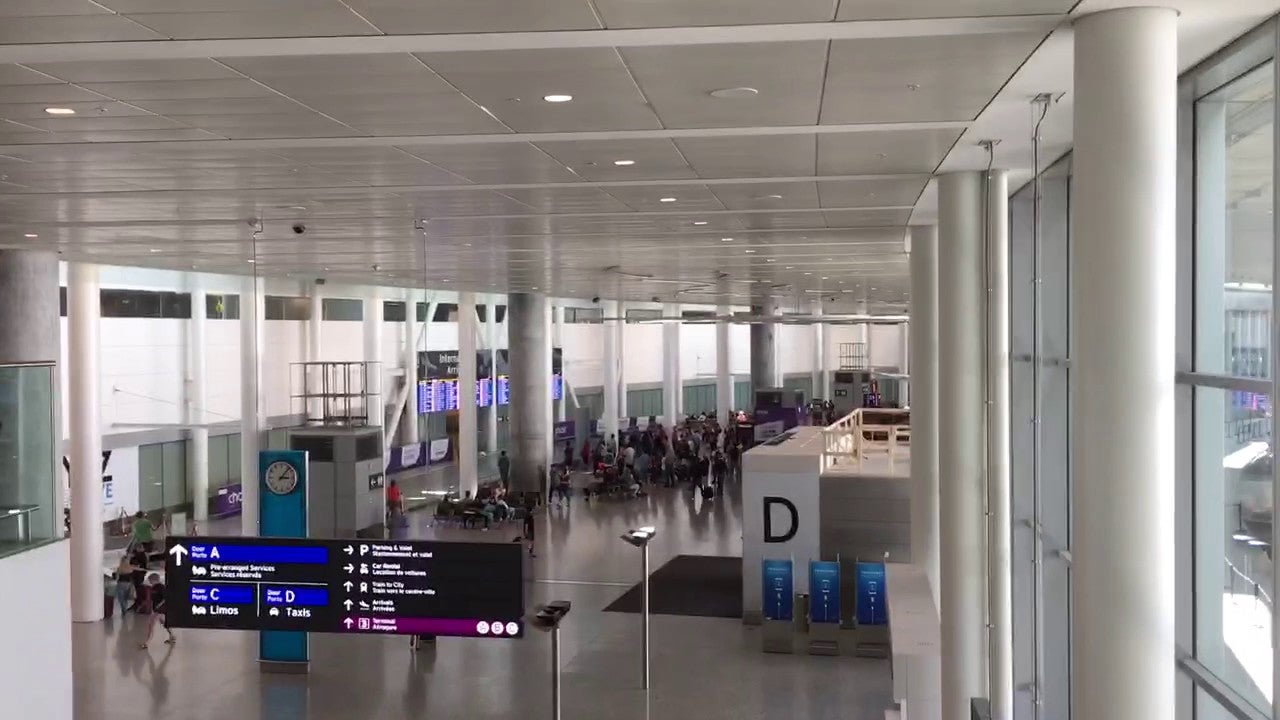
Once you are in the terminal, look for the Customs/Passport Control signs and follow them. This may be a long walk, so take advantage of the moving walkways.
Follow signs that look similar to the image below.
Step Two
You will eventually walk through a hallway with this art piece.
Continue to follow the signs to Customs/Passport Control.

Step Three
Keep following the signs to Customs/Passport Control.
You're almost there!
Step Four
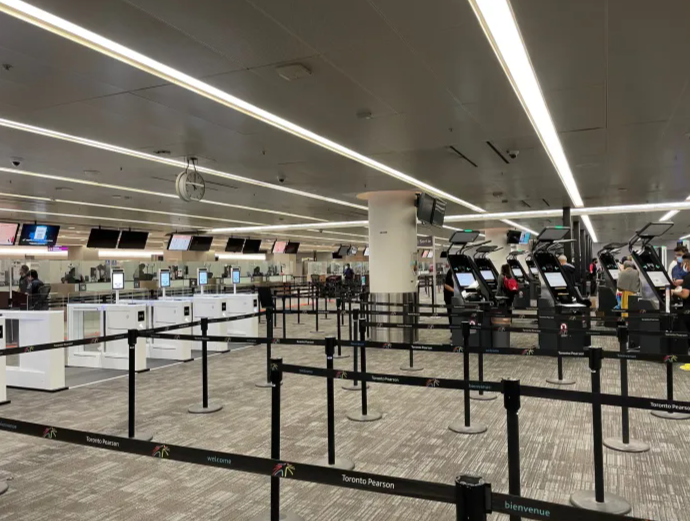
Once you have arrived at Customs/Passport Control, wait patiently in line and follow the instructions given to you. One line will be for Canadian and U.S. citizens. The other line will be for citizens of other countries. Stand in the line that is appropriate for you.
Step Five
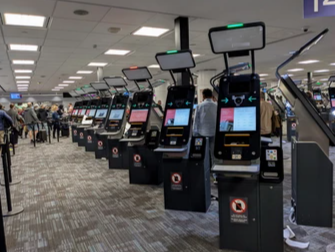
When you arrive at Customs/Passport Control, you may be directed to an eGate or Primary Inspection Kiosk (PIK) to scan your passport and complete your customs declaration. Follow the instructions on the screen, and speak to a staff member if you need help. You may be asked to speak to a customs and immigration officer. They will review your passport and other documents, and ask you some questions about your purpose for travelling to Canada. Have your Renison or University of Waterloo Letter of Acceptance ready to show the officer.
Step Six
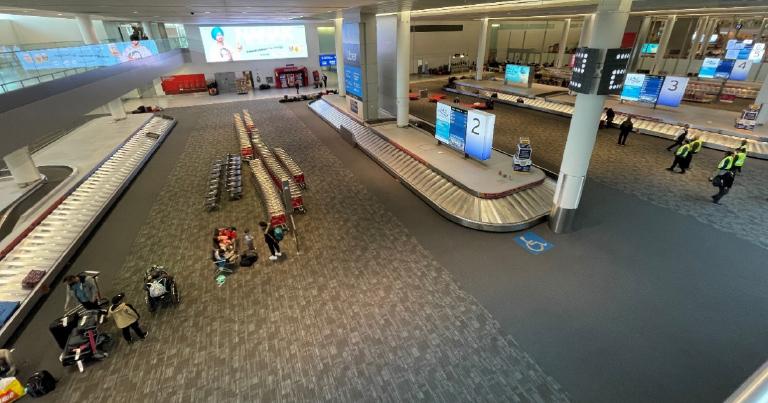
Once you have cleared passport control, you will go to the "Baggage" area to pick up your luggage and suitcases. After getting your luggage, you will line up again and another customs officer will collect your customs declaration card before allowing you to leave the secure customs area.
Step Seven
After you have left the secure customs area, you are ready to make the trip to Waterloo!
Transportation to Waterloo
Toronto Pearson Airport is located approximately 100 kilometres east of Renison University College in Waterloo. As such, there are a few different options for travelling to the Kitchener-Waterloo area from Pearson Airport.
The Ground Transportation Desk at Toronto Pearson Airport can assist with various ground transport options to get you from the Airport to Kitchener-Waterloo. Information counters are located on the Ground Level of Terminal 1 and on the Arrivals Level of Terminal 3.
Some of your options are listed below.
Weather in Canada
Waterloo is located in the southern part of Ontario, Canada's most populous province. Southern Ontario experiences four distinct seasons: fall, winter, spring, and summer. Fall (also called autumn) usually brings a mix of cool, rainy days and mild, sunny days. Freezing rain and flurries (small snowflakes) are not uncommon in late fall. Winter brings lots of snow, ice, and cold temperatures; dressing in warm, waterproof clothing will help you enjoy the winter weather! Spring sees warmer weather slowly return to Southern Ontario, but this time of transition can see a warm, sunny day quickly followed by cold or wet weather, so keep your jacket handy. Summer brings lots of warmth and sunshine, but note that many buildings will be air-conditioned, so bring a sweater if you get cold easily.
To get regular weather updates and severe weather notifications, you can download the Government of Canada's WeatherCAN app for your iOS or Android device, and select "Kitchener (Waterloo), ON" as the location. You can also visit the Kitchener (Waterloo) weather website.
Monthly average temperatures for every season in Waterloo can be found below (all temperatures in Celsius). Remember, these temperatures are averages; some days may be warmer, while other days may be cooler:
January |
February |
March |
April |
|
| Avg. High | -3° C | -1° C | 4° C | 11° C |
| Avg. Low | -10° C | -10° C | -6° C | 1° C |
May |
June |
July |
August |
|
| Avg. High | 18° C | 24° C | 26° C | 25° C |
| Avg. Low | 6° C | 12° C | 14° C | 13° C |
September |
October |
November |
December |
|
| Avg. High | 20° C | 14° C | 6° C | 0° C |
| Avg. Low | 9° C | 3° C | -1° C | -7° C |
What to pack when coming to Canada
Below is a list adapted from our Renison Student Experience and Housing team with suggestions for what to bring to Canada...
What to bring
Important documents
✓ University documents
✓ WatCard (if you have it already)
✓ Health Card
✓ Bank Card
✓ Driver's licence/other ID card
✓ Important immigration documents
Clothing
✓ Clothes for the season you plan to visit
✓ Shoes suitable for walking
✓ Slippers
✓ Bathrobe
✓ Semi-formal / dress clothes
Bath, Laundry & Grooming
✓ Shampoo, Conditioner, Deodorant, Toothbrush/Toothpaste, Razor, and other Toiletries
✓ Flip flops for the shower
✓ Towels and wash cloth
✓ Hair dryer
✓ Tissue
✓ Cold medicine, pain reliever, prescribed medicine, sunscreen
✓ Small first aid kit and flashlight
✓ Laundry bag, detergent, fabric softener
✓ Hand sanitizer and face coverings
Appliances & Electronics
✓ Mobile phone
✓ Laptop and/or tablet
✓ Headphones
✓ Earplugs
✓ Hand sanitizer and face coverings
What NOT to bring
✗ Halogen lamps
✗ Candles
✗ Incense
✗ Air conditioner
✗ Irons
✗ Pets if you plan to live on campus or with a homestay family
✗ Furniture
✗ Any items banned by the Government of Canada for airplane travel
Understanding Canadian currency
Canada’s currency is the Canadian dollar ($). One dollar is divided into one hundred cents (¢). Most businesses and restaurants accept credit cards and cash (coins and bills) for payment. Cash in Canadian dollars can be obtained from a bank or currency exchange. If you pay for something with cash, your total will be rounded to the nearest $0.05, as Canada no longer uses one-cent coins.
Canadian dollar bills (bank notes): $5, $10, $20, $50 and $100.
Canadian coins:
Nickel = $0.05
Dime = $0.10
Quarter = $0.25
Loonie = $1.00
Toonie = $2.00

If you do not have any Canadian cash, many businesses will accept Visa and MasterCard credit cards. Some businesses will also accept Visa and MasterCard-branded debit cards from foreign banks, but this is not as common compared to credit cards. Contact the business you plan on visiting by phone ahead of time if you are not sure what payment methods they will accept.
Most goods and services in Ontario will be charged a government sales tax of 13%; this tax is called the HST. The HST is not usually advertised in the price of an item; this extra charge will be added to your total bill at a store or restaurant.